Recent Posts

Saturday, November 12, 2011

"Jeopardy" contestant never heard of Joan Fontaine

Last week on the popular TV quiz show "Jeopardy", there was a question about Olivia and Joan, under the category "Hollywood History". I didn't watch the program, but apparently the question had something to do with naming the first sisters to be nominated for Oscars in the same year.

Contestant Kara Spak, a Chicago Sun Times writer with a history of embarrassing gaffes on the show,  failed to answer the Olivia-Joan question correctly. According to her own admission, she never even heard of Joan Fontaine:

I knew it would take a minor miracle for me to advance into the “Jeopardy!” Tournament of Champions two-day final. I thought that minor miracle might occur during Final Jeopardy, with the “Hollywood History” category.

It did not. I was within striking distance, but in the end, victory eluded me, along with the names of the first two sisters who had been nominated for Oscars in the same category, the Final Jeopardy question.

Joan Fontaine? I had never heard of her until Alex Trebek said her name. The sister of Olivia de Havilland? Also news to me.

Read the full text of Spak's humorous report here:
Final Final Jeopardy for Sun-Times reporter
(Chicago Sun-Times, Nov 10 2011)

At the 1941 Oscars, Joan Fontaine was nominated for Suspicion (and won), and Olivia de Havilland was nominated for Hold Back the Dawn.

This was the first time a pair of sisters were nominated in the same category. I think the last time was in 1966 when Vanessa and Lynn Redgrave were both nominated for Best Actress (and lost to Elizabeth Taylor)

A complete list of winners can be found here:

You Can't Beat Love (1937)

From RKO Pictures, this is a funny political comedy that came out in the summer of 1937, one of Joan's five films from that year. At only 62 minutes long, it was was part of a triple bill in New York, according to the NY Times review of the film.


Preston Foster plays a wealthy single socialite named "Jimmy Hughes" (perhaps a distant relative of Howard Hughes?). When we first meet him, we learn that he loves to sleeps late, has a butler named Jasper (Herbert Mundin) and doesn't have a care in the world. The opening scenes with Jimmy and Jasper are really funny. 


One day Jimmy finds himself in a rather unusual circumstance -  digging ditches with other laborers. But he's only doing it for money - some newspaper reporters dared him to work outdoors in his tuxedo for $500. The other workers taunt him for wearing his fancy duds ("Can I have the next dance?" one jokes), and when Jimmy breaks for lunch, Jasper sets up a table with champaign and caviar sandwiches!


Suddenly, the Mayor's campaign bus pulls up, hoping to earn the votes of the workers. A group of campaigners (including Joan) set up a table with free cake. Joan's character makes a speech urging everyone to re-elect the Mayor.

Preston Foster's Jimmy calls the mayor a fraud and says no one has the guts to oppose him. An aggravated Joan asks, "well why don't you do it?" Preston: "I think I will!". The rest of the movie is just as silly, and involves political mudslinging, mistaken identity, and a romance between Preston and Joan, who plays the mayor's daughter!
In one of the funniest scenes, the crooked chief of police hires a Mae West-like temptress named Bubbbles (Barbara Pepper) to seduce Jimmy and scandalize his campaign (the plot backfires).


The supporting cast includes Paul Hurst,
Barbara Pepper, and Herbert Mundlin

I enjoyed this movie, especially the supporting cast including Paul Hurst as Jimmy's bodyguard. He steals every scene. But I think I liked the first half of the movie better than the last half/ending.

Not on DVD or VHS, the movie sometimes plays on Turner Classic Movies.

Saturday, October 22, 2011

Happy Birthday Joan!

Wishing Ms  Fontaine a very happy birthday today


Birthday Wishes from
Backlots
Shadows and Satin


Friday, September 23, 2011

Beyond a Reasonable Doubt (1956)


Beyond a Reasonable Doubt (1956) is a film noir directed by Fritz Lang and written by Douglas Morrow. The film, considered film noir, was the last American film directed by Lang.

Austin Spencer (Sidney Blackmer), a newspaper publisher opposed to capital punishment, invites novelist Tom Garrett (Dana Andrews) to witness an execution. Later, Austin explains to Tom that he believes the District Attorney Roy Thompson (Philip Bourneuf) is using circumstantial evidence to win death sentences because he wants to be the next governor.

Austin wants to plant evidence that will point at a innocent man. Meanwhile, Tom proposes to Austin's daughter Susan (Joan Fontaine); she wants to announce the wedding date, but Tom's editor wants him finish his novel first.

Soon after, Austin reads in the newspaper that an exotic dancer, Patty Gray, has been strangled. Austin learns from a police detective that Patty's friends, Dolly Moore (Barbara Nichols) and Terry LaRue (Robin Raymond), saw her drive away with a man.

Tom meets Dolly after spilling a drink on her on purpose and offers to pay for cleaning her dress. Dolly is so thrilled to have a wealthy boyfriend that she does not notice when Tom takes her body makeup.

When Susan sees a picture of Tom and Dolly in the newspaper, she breaks off their engagement.

Tom and Austin go to the scene of the crime. Austin takes a picture of Tom leaving his cigarette case as a false clue. That night at the club, Terry worries that Tom may be Patty's killer, so she decides to call police lieutenant Kennedy to inform him about her upcoming date with Tom.

Austin, takes pictures of all his activities as proof of his innocence, Tom cleans his car of all fingerprints, applies body makeup to the car seats and leaves a stocking in his glove compartment. When Tom picks up Sally for their date, the police arrest him. The police interrogate Tom, who answers their questions truthfully. When he is indicted for murder, Susan wants Austin to intervene, and wonders why her father does not seem concerned.

Thompson is ready to try the case in court, but his assistant, Bob Hale (Arthur Franz), is in love with Susan and wants to help her prove Tom's innocence. At the trial, Thompson tells the court that Tom proposed to Susan just five days before Patty's murder, and killed the dancer to hide his affair with her.

As "evidence," he talks about a large cash withdrawal Tom made from his bank on the same day that Patty went to work with a lot of cash, as well as pipe ashes found in Tom's garbage, even though Tom does not smoke.

As the jury deliberates, Austin heads over to Thompson's to reveal their plot, but.. along the way is hit by a car and all the evidence is burned. After Austin's death, Tom tells the true story to his lawyer, Jonathan Wilson, who tells the judge, but the judge cannot stop the trial. Susan and Jonathan, search Austin's safe for the pictures, but find none. When the police go through the burned photographs, Susan is convinced of Tom's innocence, and tries to convince the newspaper editors to sway public opinion in Tom's favor.

No pardon is granted and the night before Tom's execution, Susan begs Bob to investigate further. He learns that Patty, stole money from her boyfriend who then threatened to kill her. Unfortunately, the boyfriend died years earlier. A lawyer arrives at Thompson's office, with a just-discovered note that Austin left in his safe-deposit vault, which clears him of all guilt. But.. is he really Innocent?

I thought this was a very interesting film that it gets you thinking about how someone really could be killed for something they didn't do. Beyond a Reasonable Doubt also has one of the best final twists which comes as a complete surprise.


Tuesday, September 6, 2011

The Heiress (1949)


The Heiress (1949). Directed by William Wyler. Camera: Leo Tover. With Olivia de Havilland, Montgomery Clift, Ralph Richardson, Miriam Hopkins, Vanessa Brown, Betty Linley, Ray Collins, Mona Freeman, Selena Royle, Paul Lees, Harry Antrim, Russ Conway, David Thursby, Donald Kerr, Harry Pipe, Una Mortished, Ralph Sanford, Lester Dorr, Franklyn Farnum, Douglas Spencer, Jack Chefe.


A wealthy widowed physician Austin Sloper, does not understand why his socially awkward daughter Catherine, does not have all the wonderful qualities of her beautiful mother, even with all her schooling and training. Austin, asks his sister, Lavinia, to come stay with him to help teach his daughter social graces.


That night at a party, Austin's sister, Elizabeth and her husband Jefferson, announce the engagement of their daughter Marian to Arthur Townsend. Arthur's handsome cousin Morris, asks Catherine to dance. Although, she has two left feet, Morris does not seem to notice and asks if he could see her again. Morris, makes frequent visits to her home the following week, her father seems surprised that someone has taken any interest in his daughter.


One night, Lavinia pretends to have a headache and when she leaves Morris and Catherine alone together, he proposes. Catherine accepts, despite the fact Morris is unemployed, uneducated and squandered away his inheritance in Paris.

Catherine, who can not wait, announces her engagement to Austin, who then calls for Morris' sister, Mrs. Montgomery to come visit. She confirms Austin's suspicions, that Morris is after Catherine's substantial inheritance. Austin, convinces Catherine to travel with him to Europe for six months, and Morris promises to wait for her.

While Austin and Catherine are in Europe, Morris visits Lavinia and settles in to a luxurious life style. Austin, soon realizes that Catherine still still in love with Morris, and they return to New York. Where Austin, tells his daughter that because she is homely and dull, her only attraction is her money, and the only thing she does well is her neat embroidery work. Shocked by her father's feelings for her, Catherine plans to elope with Morris that night, and tells Morris her father's threat of disinheriting her. Catherine, is packed and ready and waiting, but, Morris never shows up. Lavinia, who agrees that Morris is a fortune-hunter, feels that he at least offered Catherine a small chance at happiness.

A week later, Austin becomes ill and Catherine learns that Morris has moved to California. Catherine, is heartbroken, and she refuses to see her father when as he lays dying.

Years later, Morris returns to see Catherine. Although she refuses to see him at first, she changes her mind when she hears his voice. Morris, then asks for her forgiveness and tells her the reason he left was so she would not loose her inheritance. Morris, proposes again, saying that he needs her love, and Catherine encourages him to elope that night. Will they now marry and live happily ever after?


Fun Fact:

Montgomery Clift learned to play the piano for the scene where he sings, "The Joys of Love" to Olivia de Havilland.

Olivia De Havilland's, performance from a naive girl to a bitter woman is perfectly believable. Montgomery Clift, performance was just right for his part as a fortune hunter. It is hard to know which side to root for.. You might agree with Dr. Sloper's thoughts about Morris and only wants to protect his daughter. Morris could be a fortune hunter, or he could be a man who could make her happy. A wonderfully told story.

Friday, July 29, 2011

Two Joan Fontaine Films Coming Soon to Stanford Theater (Palo Alto, CA)

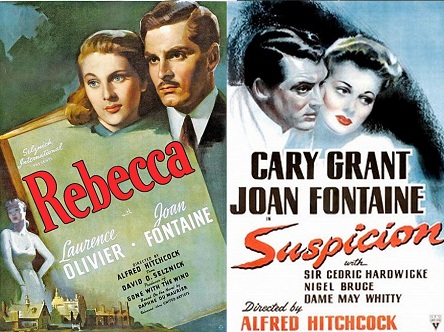
In September the Stanford Theater in Palo Alto, California will be showing Rebecca and Suspicion. 

From September 10-16

Rebecca will be showing at 7:30, plus 3:20 Sat/Sun

Suspicion will be showing at 5:40 and 9:50


The're a great lineup of other Hitchcock movies this summer at the Stanford including To Catch a Theif, Notorious, The 39 Steps, and this weekend, Strangers on a Train and North by Northwest. 

If I lived within driving distance I would be there quite often this summer!

Saturday, July 9, 2011

Darling, How Could You! (1951)


Set in the early 1900s, this is a comical film about two absentee parents (Joan Fontaine and John Lund) who return to their home in New York City to meet their young children for the first time in years. The reason for their absence is their job in the jungles of Panama where they were doctors, perhaps even missionaries.  In the original 1905 play "Alice Sit By the Fire" by JM Barrie, the father is a Colonel in the British military.

The parents arrive at home expecting to be warmly welcomed; instead they find out that the nurse for their baby is overly protective. Their young son unloads his grievances on them, including his complaint that he doesn't like his birth name. And they find that their eldest daughter Amy (Mona Freeman) has matured into a young woman and doesn't know how to relate to her mother. It's funny when Joan Fontaine gasps,"she knows all about life...and the seamy side!"

The rest of the movie is all about the couple adjusting to life back at home and learning how to relate to their kids, and vice versa. I think the film would have worked in a modern-day setting, but it is a period film just like JM Barrie's play (though the film takes numerous liberties).

There is another subplot involving the kids' paranoia when they mistakenly think their mother is having an affair; the climax of the film ends with an explosion of hysteria, and funny comedic moments from all.

Another highlight of the film is when Joan Fontaine plays the piano at home, and later singing a lullaby to her baby.

(Admin. note: If anyone knows the lyrics or title of this lullaby, please let us know) 

(Admin. note, 7.17.2014 - Thank you, Laura, for identifying this piece of music as being Brahms Waltz in A-Flat Major, Op. 39 No. 15)

Directed by the great Mitchell Leisen. Co-starring Willard Waterman (Radio's The Great Gildersleeve), Billie Bird (Police Academy 4) and Peter Hansen (TV's General Hospital)

Spoiler: No one in the film says "Darling, how could you!"